


Cleanliness is part of Imaan (Belief)
Taken from iccuk.org
By Dr. Mozammel Haque
Today I will be discussing, Insha Allah, one of the most important practical aspects of Islam which is cleanliness. Islam is beautiful and that's why its followers are beautiful and clean. But when you move around the High Street of any European country and come across any dirty shop, you would be surprised to know that the owner of that shop is none other than a Muslim.
The Muslim whom Islam wants to stand out among people is very clean. He has high standards of personal hygiene, bathing frequently in accordance with the guidance of the Prophet (peace be upon him) who encouraged people to wash themselves completely and wear perfume, especially on Fridays: "Have a bath on Fridays and wash your heads, even if you are not in a state of Junabah (impurity, e.g. following marital relations), and wear perfume.” (Al-Bukhari).
The Prophet (pbuh) placed such a great emphasis on cleanliness and bathing that some of the four Imams considered performing ghusl before Friday prayer to be obligatory (wajib). Abu Hurayrah (RA) said: "The Prophet said: ‘It is the duty of every Muslim to take a bath (at least) once every seven days, and to wash his head and his body.” (Agreed upon)
The true Muslim keeps his clothes and socks clean, checking them from time to time, to be sure that they have no unpleasant smell. He also wears perfume to help keep him clean. It is reported that ‘Omar (RA) used to say: "Whoever spends a third of his wealth on perfume is not being extravagant.”
The smart Muslim takes care of his mouth, for no one should ever have to smell an unpleasant odour coming from it. He does this by cleaning his teeth every day with a siwak, toothbrush, toothpaste and mouthwashes. Aishah narrated that the prophet (pbuh) "never woke from sleeping at any time of day or night without cleaning his teeth with a siwak before performing wudu.”
The Prophet's concern for oral hygiene was so great that he said, "If it were not for the fact that I did not want to overburden my Ummah, I would have ordered them to use the siwak before every prayer.” (Al-Bukhari and Muslim). Aishah (RA) was asked what the Prophet (pbuh) used to do first when he came home. She said: "Use siwak.” (Muslim).
Regrettably, some Muslims neglect these teachings that are at the heart of Islam, and do not pay heed to the cleanliness of their mouths, bodies and clothes. So you may see them going to the mosque or to other religious meetings and study circles, annoying their brothers with their unpleasant smell and offending the angels who surround these blessed gatherings. What is really strange is the fact that they themselves listen to and repeat the saying of the Prophet (peace be upon him) that whoever eats onions, garlic or leeks should not go to the mosque because his breath may disturb the angels and the people:
"Whoever eats onions, garlic or leeks should not approach our mosque, because whatever offends the sons of Adam may offend the angels.” (Muslim).
The Prophet (pbuh) banned those who had eaten these pungent vegetables from coming anywhere near the mosque, lest the people and the angels be offended by their bad breath, but these smells pale into insignificance beside the stench of dirty clothes, filthy socks, unwashed bodies and unclean mouths that emanates from some careless and unkempt individuals who offend others in any gathering.
Imam Ahmad and Imam al-Nisa'I narrate that Jabir (RA) said: "The Messenger of Allah (pbuh) came to visit us, and saw a man who was wearing dirty clothes. He said, ‘Could this person not find anything with which to wash his clothes?'”
The Prophet (pbuh) did not like a Muslim to appear before people wearing dirty clothes, if he had the means to clean them. He encouraged Muslims always to dress in clean clothes and to present a neat and attractive appearance. He used to say: "There is nothing wrong with keeping two garments for Friday, apart from one's workaday clothes.” (Reported by Abu Dawud, Ibn Majah.)
Islam frequently encourages its followers to be clean always, to perfume their clothes and to ensure that their bodies always smell fresh and clean. This is what the Prophet (pbuh) used to do, according to the report that Imam Muslim quotes from Anas ibn Malik, who said: "I have never smelt any ambergris or musk that had a better scent than the scent of the Messenger of Allah (pbuh).”
Many reports describe the cleanliness of the Prophet's clothes and body, and describe the sweet smell of his sweat. For example, if he shook hands with a man, his beautiful scent would remain on that man's hand for the rest of the day, and if he laid his hand on the head of a child, that child would stand out from others by virtue of his sweet smell.
How urgent is the Muslims' need to follow the guidance of this great Messenger in his command to take care of one's hair and keep it neat in accordance with the teachings of Islam. This is reported in the Hadith that Abu Dawud quotes from Abu Hurayrah (RA), who said: "The Prophet (pbuh) said: ‘Whoever has hair, let him look after it properly.'”
Looking after one's hair, according to Islamic teaching, involves keeping it clean, combing it, perfuming it and styling it nicely.
The true Muslim takes good care of his clothes, so you will see him presenting a pleasant appearance, without being extravagant. He is pleasant to look at and to meet, and does not annoy people with his careless, disheveled appearance. He always checks himself before he goes out to meet people, and he makes himself look good, in moderation, for the Prophet (pbuh) used to make himself look good in from his Companions, as well as in front of his family. In his commentary on the ayah (verse), "Say: Who has forbidden the beautiful (gifts) of Allah, which He has produced for His servants, and the things, clean and pure, (which He has provided) for sustenance?….” (al-A''raf 7:32)
Al-Qurtubi said: "Makhul reported from Aishah (RA): "A group of the Companions of the Prophet (pbuh) was waiting at the door for him, so he prepared to go out to meet them. There was a vessel of water in the house, and he peered into it, smoothing his beard and his hair.
(Aishah said:) I asked him, "O Messenger of Allah, even you do this?” He said, "Yes, when a man goes out to meet his brothers, let him prepare himself properly, for Allah is beautiful and loves beauty.””
The Muslim does all of this in accordance with the Islamic ideal of moderation, avoiding the extremes of either exaggeration or negligence.
First Published in The Muslim WorldKarachi, Pakistan
Showing posts with label Wudu. Show all posts
Showing posts with label Wudu. Show all posts
Saturday, December 8, 2007

Monday, September 17, 2007
Basic guide to Wudu, Al-Ghusl & Tayammum
The following has been taken from a forum from turntoislam.com posted by islamicfajr
Cleanliness (Taharah) is an important precondition of Islamic worship.
Wudu
Wudu is an essential part of Cleanliness. Salah(prayer) is not valid without Wudu' or Tayammum(dry Ablution).
Allah says in the Qur'an :
"Surely Allah loves those who turn to Him and those who care for cleanliness" (2:22).
1. First make Niyyah (Intention) that you are making Wudu' for Salah

2, 3, 4 rinsed ur mouth and cleaned ur nose with water (three times)


5, 6 Wash your face three times from right ear to left ear and from forehead to throat.


7. Wash your right arm and then your left arm thoroughly from wrist up to elbow three times.

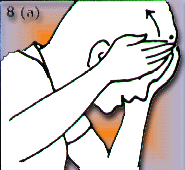
( 8 a & b) Move the wet palms over the head from the top of forehead to the back of the head.

9) Pass the wet tips of index fingers into the grooves and holes of both ears and also pass the wet thumbs behind the ears

10. Finally, wash both feet to the ankles starting from the right, making sure that water has reached between the toes and all other parts of the feet.

At the end of the above steps recite: "Ash-hadu an la ilaha illal lahu wa ash-hadu anna Muammadan 'abduhu wa rasuluh." Meaning: I testify that there si no god but Allah and He is One and has no partner and I also testify that Muhammad is His servant and messenger.
You Should repeat your Wudu after :
1. Natural discharge (e.g. urine, stool, wind and the like)
2. Flow of blood or pus from any part of the body.
3. Full mouth vomiting
4. Falling asleep.
Al-Ghusl (The Washing Or Bath)
The greater purification, Al-Ghusl, is obligatory when one is defiled as a result of nocturnal emission (or a wet dream),marital intercourse, child birth, or when entering into the fold of Islam.
The procedure is as follows: Begin with the name of Allah as for Wudu. Wash the hands and the affected parts of the body with water to remove any impurity. Perform Wudu as above. Then wash the whole body three times, using clean water for each wash.
Tayammum (Dry Ablution)
On certain occasions, it may become either impossible (e.g.. when water cannot be found or just enough for drinking is available), or it is dangerous, because of illness, to use water for Wudu or Al-Ghusl. In such situations, Tayammum (dry ablution) is performed.
The Procedure: Begin with the name of Allah. Strike both palms on sand, or anything containing sand or dust, like a wall or stone etc., against with the palms. Rub the right hand with the left palm from the wrist to the elbowed similarly for the left hand with the right palm. Finish with the Kalimatu Ash-Shahadah as for Wudu. Having Cleansed yourself by Wudu, you can now proceed to perform Salah. You must have a clean body, a clean place and wear clean clothes before you start offer Salah .
Cleanliness (Taharah) is an important precondition of Islamic worship.
Wudu
Wudu is an essential part of Cleanliness. Salah(prayer) is not valid without Wudu' or Tayammum(dry Ablution).
Allah says in the Qur'an :
"Surely Allah loves those who turn to Him and those who care for cleanliness" (2:22).
1. First make Niyyah (Intention) that you are making Wudu' for Salah
N.B the place of intention is the heart and begin saying. "Bismillah.." (In the name of Allah, the most merciful and the most kind).
Wash both hands up to the wrist three times, making sure that water has reached between the fingers.

2, 3, 4 rinsed ur mouth and cleaned ur nose with water (three times)
Put a handful of water into your mouth and back it Sniff water into your nostrils three times to clean them and then wash the tip of the nose.


5, 6 Wash your face three times from right ear to left ear and from forehead to throat.


7. Wash your right arm and then your left arm thoroughly from wrist up to elbow three times.

( 8 a & b) Move the wet palms over the head from the top of forehead to the back of the head.


9) Pass the wet tips of index fingers into the grooves and holes of both ears and also pass the wet thumbs behind the ears

10. Finally, wash both feet to the ankles starting from the right, making sure that water has reached between the toes and all other parts of the feet.

At the end of the above steps recite: "Ash-hadu an la ilaha illal lahu wa ash-hadu anna Muammadan 'abduhu wa rasuluh." Meaning: I testify that there si no god but Allah and He is One and has no partner and I also testify that Muhammad is His servant and messenger.
You Should repeat your Wudu after :
1. Natural discharge (e.g. urine, stool, wind and the like)
2. Flow of blood or pus from any part of the body.
3. Full mouth vomiting
4. Falling asleep.
Al-Ghusl (The Washing Or Bath)
The greater purification, Al-Ghusl, is obligatory when one is defiled as a result of nocturnal emission (or a wet dream),marital intercourse, child birth, or when entering into the fold of Islam.
The procedure is as follows: Begin with the name of Allah as for Wudu. Wash the hands and the affected parts of the body with water to remove any impurity. Perform Wudu as above. Then wash the whole body three times, using clean water for each wash.
Tayammum (Dry Ablution)
On certain occasions, it may become either impossible (e.g.. when water cannot be found or just enough for drinking is available), or it is dangerous, because of illness, to use water for Wudu or Al-Ghusl. In such situations, Tayammum (dry ablution) is performed.
The Procedure: Begin with the name of Allah. Strike both palms on sand, or anything containing sand or dust, like a wall or stone etc., against with the palms. Rub the right hand with the left palm from the wrist to the elbowed similarly for the left hand with the right palm. Finish with the Kalimatu Ash-Shahadah as for Wudu. Having Cleansed yourself by Wudu, you can now proceed to perform Salah. You must have a clean body, a clean place and wear clean clothes before you start offer Salah .
Subscribe to:
Posts (Atom)


